
 = Partner Site
Possessive Adjectives Worksheets
Possessive adjectives—my, your, his, her, its, our, their—show ownership and always appear before a noun. These worksheets help students identify possessive adjectives, use them correctly in sentences, and distinguish them from possessive pronouns (mine, yours, his, hers, ours, theirs) and contractions (it’s vs. its, your vs. you’re, their vs. they’re).
That last distinction causes the most confusion, so many of these worksheets target those commonly mixed pairs directly. Browse below for identification practice and error-correction exercises.
Possessive Adjectives

Circle the Possessive Adjectives Worksheet
In this printable activity, students will read the sentences and circle the correct possessive adjectives.

Complete the Chart! Possessive Adjectives Worksheet
Students will complete the chart with matching possessive adjectives or personal pronouns.

Fill in the Blanks Possessive Adjectives Activity
Read through each sentence and fill in the blanks with the correct possessive adjectives.

Possessive Adjectives Chart
Complete the chart with matching possessive adjectives.
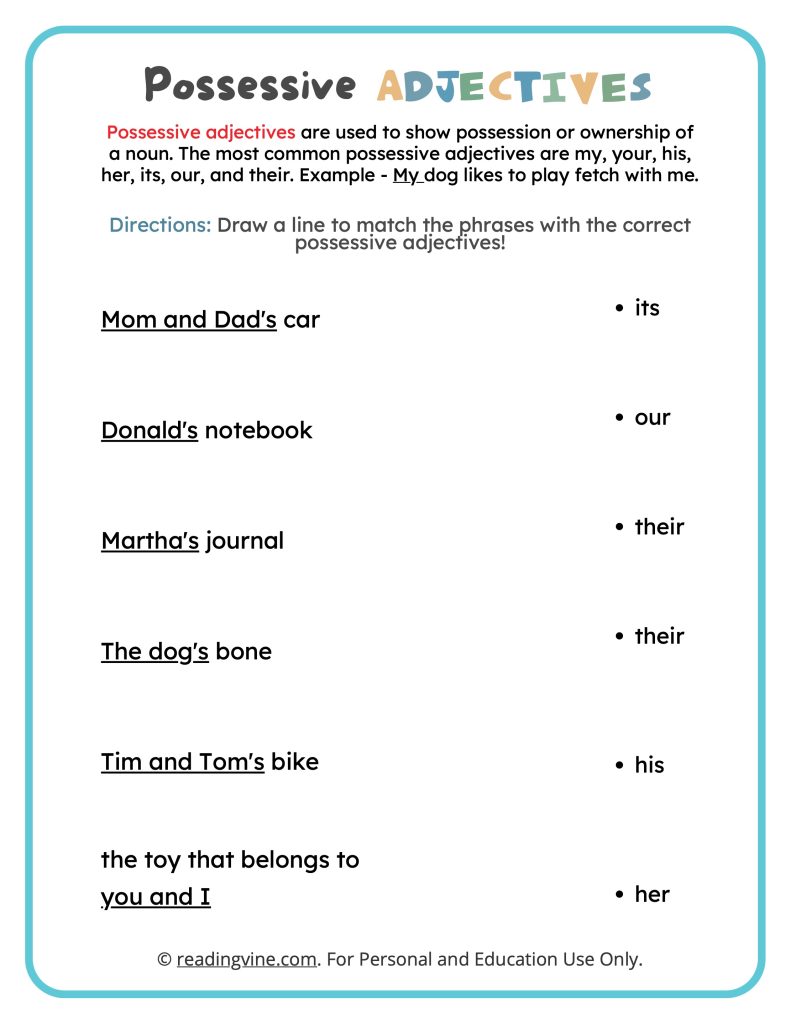
Possessive Adjectives Matching Activity
Practice identifying the correct possessive adjectives with this fun, printable matching game for students!

Possessive Adjectives Chart Writing Activity
Students will complete the chart with matching possessive adjectives and personal pronouns. Then, they will be asked to write an original sentence using the given possessive adjective.
Grade-Level Placement: Possessive adjectives typically appear in grades 2-3, often alongside demonstrative adjectives in a “special adjectives” unit. Students use these words correctly in speech long before formal instruction, so the focus is recognition and avoiding written errors.
The Homophone Problem: The biggest teaching challenge isn’t the possessive adjectives themselves—it’s the sound-alike errors: “their/there/they’re,” “your/you’re,” and “its/it’s.” Worksheets that present these pairs in context build proofreading habits that stick. Emphasize that possessive adjectives never have apostrophes.
Quick Student Test: Teach this check: “Can I replace this word with ‘my’?” If yes, it’s a possessive adjective and takes no apostrophe. “Its fur is soft” → “My fur is soft” works, so “its” is correct. This simple substitution helps students self-edit without memorizing rules.
